 |
 |
 |
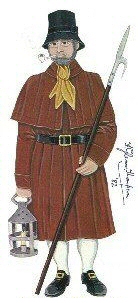
A Dublin Charlie
of the 18th Century |
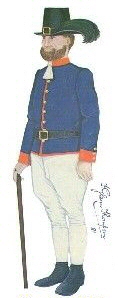
A Carrick-on-Suir
Constable 1787 |
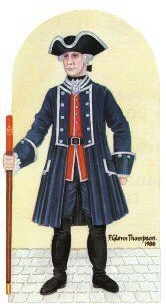
A Kilkenny Constable
late 18th Century |
Organized policing in Ireland commenced with the formation of the Dublin Police in 1786. Prior to the Dublin Police Act, law and order in Irish towns and cities was maintained by watchmen (Night watchmen had protected Ireland's
Norman towns and cities from about the 14th century), parish constables and the military. Between 1723 and 1785, civil patrolmen known as the 'Charlies' (see F. Glenn Thomson's illustration) policed the city of Dublin. They were
glorified parish constables and often figures of fun. The armed constables and watchmen of the Dublin Police were replaced by an unarmed civil police force in 1795.
In 1787, the Baronial Police ("Old Barneys") was created to police the remainder of Ireland. All appointees had to be Protestants, a clause that was later removed after the Penal Laws were abolished. In 1869 Robert Curtis, in
his book 'History of the Irish Constabulary', claimed that three quarters of the R.I.C. were Roman Catholic.
The Baronial Police was an undisciplined force without a set uniform, dealing only with minor crimes and offences. They relied on the military to suppress serious disturbances, such as the 1798 Rebellion, the numerous faction fights,
drunken brawls, attacks and raids by Secret Societies, Raparees, Tories and pirates.
So, even after the creation of the "Old Barneys" many rural towns
retained their own police forces or Watch system. Typical examples are Carrick-on-Suir and Kilkenny. In 1787, Carrick-on-Suir's police "the Carrick Constables" (see illustration) wore blue tunics trimmed with crimson, white
breeches, and a round hat with a feather plume.
Kilkenny City's Watchmen were known as Kilkenny Constables. The watches were of varying strengths and some were more ornate than others. By 1867 the Kilkenny Watch had dwindled to four men. This F. Glenn Thompson illustration
of a Kilkenny Constable is based on a description which appears in "Recollections of the Life of John O'Keeffe", published in 1826. In 1770, the Kilkenny Rangers were formed to protect "the neighbourhood of Kilkenny from the
ravages of the Raparees and Tories" (Dublin Evening Post, 27 May 1783).
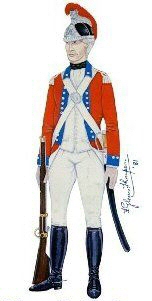
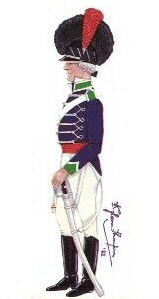
In the latter part of the 18th Century the Yeomanry and Irish Volunteers (which consisted of a variety of military units such as the Athlone Rangers, Shinrone Volunteers, Naas Light Dragoons) were called upon to protect the towns and cities, prevent crimes, arrest and take prisoners to the courts, jails or gallows.
 |
 |
 |
Tullamore True Blue Ranger
Founded 28 October 1778 |
A Yeomanry Cavalary Trooper
of the late 18th Century |
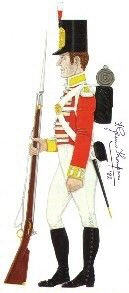
Waterford Militiaman
Battalion Company, 1805 |
The Tullamore True Blue Rangers which was formed on 28 October 1778, also carried a variety of police roles during the period of Grattan's Volunteers. The Tullamore True Blues were commanded by Colonel Charles William Bury. They wore a red uniform with blue facings. Their motto was 'Fortis Cadere Cedere non Potest' - (The brave may fall but cannot yield).
An auxiliary military force "The Irish Militia" (see the F. Glenn Thompson illustration of a Waterford Militiaman, distinguished by the yellow facings on their uniforms) were formed in 1793 to perform many of the police duties performed by the Irish Volunteers and Yeomanry. Their duties included enforcement of the illicit distillation laws and seizure of illegal publications.
Sir Robert Peel (Chief Secretary in Ireland
1812-1818) attempted to improve the situation with the creation of the "Peace Preservation Force" in 1814. The PPF and could be sent to
any part of Ireland to control areas in a "state of disturbance". Without set uniforms many of the PPF, many of whom were ex-militia or
ex-soldiers after returning from the Napoleonic Wars, donned the uniforms of their former military units while performing their policing
duties. This practice of wearing their military uniforms for policing duties continued until 1828 when a standard uniform was issued to
the County Constabulary.
 |
 |
 |
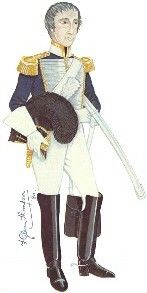
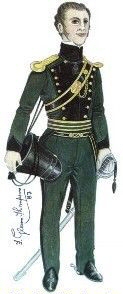
An Officer of the Dublin
Horse Police, c.1820 |
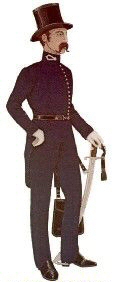
A Cadet of the County
Constabulary, 1822 |
A Constable of the
Mounted troop, c.1845 |
The military influence on police
uniforms of the day can be seen from the illustration of the elegant Dublin Horse Police uniform of the 1820s which resembled that worn
by the Light Dragoons.
The Constabulary Act of 1822 created
four provincial police forces, known as the County Constabulary, with depots in North (Armagh), East (Daingean), Ballinrobe (West) and
Ballincollig (South). The F. Glenn Thompson illustration of a County Constabulary Cadet is based on a miniature painting of Louis Anderson
who was appointed as a Cadet to the mounted branch of the County Constabulary in 1822. The uniform contains certain Light Cavalry
characteristics in the pickers and chain worn on the pouch belt. The County Constabulary were issued a standard uniform in 1828.
The Constabulary (Ireland) Act, 1836, introduced by Thomas Drummond, Under
Secretary for Ireland, centralised the police forces (with about 5,000 men) under the direct control of a Inspector-General in Dublin
Castle with a standard code of regulations and became known as the 'The Constabulary of Ireland'.
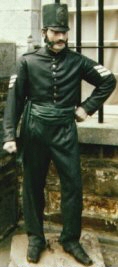
A County Constable
outside the
Tarbert Bridewell,
Co. Kerry |
A year later the first "Irish
Constabulary Code" was published with a comprehensive code of discipline and regulations and decreed that the standard colour of the
uniform would be rifle green. The new force did not have jurisdiction in Dublin, Belfast and Derry, who had their own police forces.
Following serious sectarian violence the Belfast Borough Police (Belfast Bulkies) was abolished in 1865 and replaced by the Irish
Constabulary. The Londonderry Borough Police ("Horney Dicks" perhaps due to the bone reinforcements in their top hats) were disbanded
in 1869 and replaced by the Royal Irish Constabulary following an inquiry into the deaths of two Apprentice Boys who were killed in
riots during the visit of Prince Arthur.
The Revenue Police was formed in 1832 to enforce the unpopular excise laws.
The R.I.C. was later given the Revenue Police's unpopular work when the two forces were amalgamated with the R.I.C in 1857.
A Royal Irish Constabulary officer, G. Garrow Green, described his first taste of poitín, "In the Irish Constabulary"
(Hogges, Figgis & Co. Ltd.) as; - "What an aromatic peaty flavour it had and a consistency almost like a liqueur not thin like the legal
article. It was the brew of the purest and slightly over proof, as I had abundant proof of next morning, not being addicted to strong
waters".
In 1839 a Reserve Force of 200 men was created for assignment by the Inspector General to assist the
Irish Constabulary in any part of Ireland. The Depot at the Phoenix Park was built to house the Reserve Force and as a training centre
for the Irish Constabulary replacing the four provincial training centres. The Depot also later housed a riding school and the Irish
Constabulary Band (1861).
The Force grew to over 8,600 men in 1841 and gradually began to have its effect on law and order with
the quashing of William Smith O'Brien's Young Ireland rebellion of 1848 without military support.
In 1867 the Irish Constabulary were granted the title of 'Royal' by Queen Victoria for their
part in suppressing the 1867 Fenian Rising, and so became the first "Royal" police force in the British Empire. Queen Victoria also
granted the "Royal Irish Constabulary" the harp, crown and shamrocks of "The Most Illustrious Order of St. Patrick".
The policeman of 19th century Dublin was indistinguishable from his counterpart in London.
In the Irish capital the DMP was modelled on the New Police, an unarmed civil police
force dedicated to crime prevention through exemplary personal conduct and devotion to duty.
None of the early uniforms of the DMP have survived as far as
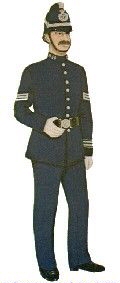
is known. The top hat was replaced circa 1860 by the helmet which became the most characteristic feature of the policeman's appearance
in many parts of the world. The illustration of the DMP foot police Sergeant circa 1880 is dressed in the style of the London Metropolitan
Police of the same period. Only one example of the crested helmet is known to have survived; it is now in the
Garda Síochána Museum.
 |
 |
 |
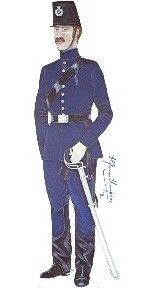
A Constable of the DMP
Mounted troop, c.1858 |
A Sergeant of the DMP
Foot Police, c.1880 |
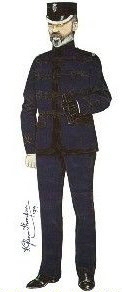
Inspector Denton Booth of the
DMP Foot Police, c.1890< |
At that time in Dublin the inspector's uniform of Dublin's foot police circa 1833 with dress tunic and cap suggests a French influence,
but which probably derived from the top hat of earlier years. With the crested helmet worn by by constables and sergeants of the same
period, this head gear disappeared in the redesign of the DMP uniforms in 1900, to be replaced
by the now familiar broad crowned forage cap. No example of the uniform depicted has survived.
By 1900 the R.I.C. had about 11,000 men (70% of whom were Catholic) stationed in about 1,600 barracks. They were subjected to strict
discipline with no official hours of duty or rest periods. Members could not serve in their native counties and had to have at least 7 years service before getting married. The intended wife had to be vetted by the superior officers before getting married. If permission
to marry was obtained the couple were transferred to a county where neither had relatives.
 |
 |
 |
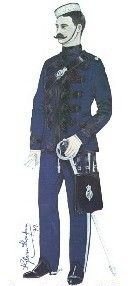
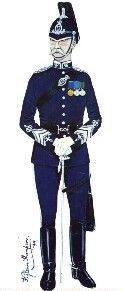
Inspector Chase of the DMP
Mounted Troop in distintive
Patrol Jacket, worn with
undress uniform, c.1898 |
Inspector Chase of the DMP
Mounted Troop wearing full
dress mounted order c.1914 |
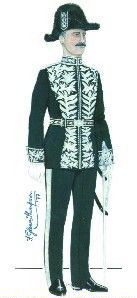
The Commissioner of
the DMP in full dress
cermonial uniform |
The early years of the 20th century brought an array of elegant dress uniforms as Ireland played host to three British Monarchs.
The illustration shows Inspector Chase of the Mounted Troop, D.M.P. wearing full dress, mounted order, circa 1914, wearing medals
commemorating the Royal Visits to Ireland by Queens Victoria, King Edward VII and King George V. His medals from left to right -
Queen Victoria's Medal to commemorate the Royal Visit, 1900; King Edward VII's Medal to commemorate the Royal Visit, 1903; and
King George V's Medal to commemorate the Royal Visit 1911. By the turn of the century the duties of the Mounted Troop were largely ceremonial. In 1919 the Troop was abolished. Only one of the
plumed helmets of the old horse police is known to have survived; it is in the Garda Síochána Museum. After Queen Victoria's death, the other members of the Mounted Troop wore a King's
crown on their insignia; it is interesting to note that Inspector Chase continued to wear a Queen's crown on his helmet plate, collar,
shoulder belt and sabretache.
The Commissioner of the DMP in full dress ceremonial uniform. When the last Commissioner of the DMP under British rule, Lt Col Sir Walter
Edgeworth Johnstone died in 1936, the Police College in Bramshill acquired his dress uniform. In 1963, this handsome reminder of a
decorative period in Irish Police history was presented to the Garda Síochána and is now in the Garda Museum.
 |
 |
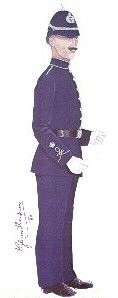 |
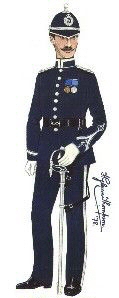
DMP Officer in
full dress uniform |
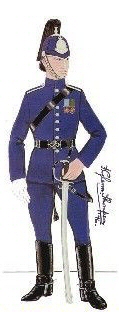
Constable of the DMP
Mounted troop in full
dress mounted order, c.1913 |
A Crown Sergeant of
the DMP, c.1922 |
Officers of the DMP were required to appear in ordinary uniform when in charge of parties of police on inspection duty, and in the presence of the Viceroy on State occasion. They wore their dress uniforms on the direction of the Commissioner until 1919, when the
Viceregal Commission under Justice Sir John Ross recommended "that full-dress uniform should no longer be required in either of the
Irish Police Forces".
The early 1900's brought about a revival in Nationalism and Unionism with the creation of private armies
such as the Ulster Volunteer Force, National Volunteers, Irish Volunteers and the Irish Citizens Army. The relative calm that the R.I.C.
had experienced since the Land War of 1879-1882 was about to end. Following the executions of the leaders of the 1916 Easter Rising and
the 1918 threat of conscription there was widespread civil unrest and resistance (both armed and passive) to British rule. Arthur
Griffith's Sinn Féin won a landslide victory in 1918 and refused to take up their parliamentary seats in Westminster, instead the formed
their own parliament in Dublin. On 21 January 1919, the same day that the members of the new parliament "Dáil Éireann" took its seats for
the first time, an intensive guerrilla war was sparked off by the Soloheadbeg Ambush by the Irish Volunteers (later renamed the Irish
Republican Army). During the next two years over 400 constables and nearly 150 soldiers were killed.
Attacks on the R.I.C. were
widespread either in their barracks or while on patrol. Richard Bennett in his book "The Black and Tans" (London) 1959, p. 47, states
that by the end of May 1920, 351 evacuated barracks were destroyed, 105 damaged, 15 occupied barracks were destroyed and 25 damaged,
19 Coastguard stations and lighthouses were raided for explosives and signalling equipment, 66 policemen and 5 soldiers were killed with
79 policemen and 2 soldiers wounded. DeValera and other members of the Sinn Féin government "Dáil Éireann", which claimed to be ruling
Ireland in absentia, urged the shunning of the R.I.C. and their families by their neighbours and friends as agents of a foreign power.
Widespread resignations from the R.I.C. followed.
Lloyd George's London Government created a temporary police force to supplement
and assist the R.I.C. in their duties in the alarming situation, which was developing in Ireland. They were employed on a contract basis
as Temporary Constables and recruited from unemployed rank and file World War One veterans. The recruits came from England, Scotland and
Wales, with possibly a third of the new recruits from Ireland.
Shortly after their arrival in Ireland in March 1920, the Temporary
Constables, whose duty was to hunt the IRA wore a dark bottle green and khaki uniform, were nicknamed the "Black and Tans" after a famous
pack of hounds. Due to a shortage of R.I.C. dark bottle green uniforms that the Temporary Constables were dressed in a uniform, which was
half black (the rifle green police) and half khaki (army).
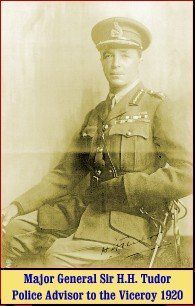 In May 1920, Major General Sir Henry Hugh Tudor was appointed as police
advisor to the Viceroy and commanding officer of both the Royal Irish Constabulary (R.I.C.) and the Dublin Metropolitan Police (D.M.P.).
However, as the authorities tried to go on the offensive with the "Black and Tans" the R.I.C. resignations continued with over 500
resignations from the R.I.C. between 1 May 1920 and 31 July 1920. Resignations increased after the Listowel Police Mutiny of 17 June 1920
when the police stationed in Listowel R.I.C. Barrack's (now Listowel Garda Station) refused to hand over their barracks to the military.
In May 1920, Major General Sir Henry Hugh Tudor was appointed as police
advisor to the Viceroy and commanding officer of both the Royal Irish Constabulary (R.I.C.) and the Dublin Metropolitan Police (D.M.P.).
However, as the authorities tried to go on the offensive with the "Black and Tans" the R.I.C. resignations continued with over 500
resignations from the R.I.C. between 1 May 1920 and 31 July 1920. Resignations increased after the Listowel Police Mutiny of 17 June 1920
when the police stationed in Listowel R.I.C. Barrack's (now Listowel Garda Station) refused to hand over their barracks to the military.
Sinn Féin created its own Republican Police to supplant the R.I.C. In June 1920, the Irish Bulletin claimed that the Republican
Police had arrested 84 criminals in 24 counties within 13 days. Three offenders who had been banished by a Republican Land Court to an
Island off the west coast of Ireland for 3 weeks refused to be rescued by the R.I.C. saying that they were loyal citizens of the Irish
Republic.
Pathe Newsreel
ARMOURED CARS ( aka ARMOURED CARS REPLACE MOUNTED POLICE DURING MILITARY RAIDS )
|
ATTEMPTED ASSASSINATION OF IRISH VICEROY
|
On 27 July 1920 a second temporary police
force was recruited from unemployed W.W.I veterans who had been officers (with two exceptions) during the war. They were given the rank
of Temporary Cadets. The Cadets who could wear either the R.I.C. uniform or army officers' uniforms with dark Glengarry caps and also
employed on a contract basis. They became known as "The Auxiliaries" or "The Auxies" because they were sent as reinforcements to the
R.I.C. and Temporary Constables. Together these new forces became known as "Tudor's Toughs" after their commanding officer.
Many of these new cadets had distinguished themselves on the battlefields of "The Great War".
Two of whom, George Onions and James Leach, had been awarded the Victoria Cross for bravery during W.W.I. However, like the German
soldiers of WW1 who were faced with similar warfare tactics after they had invaded Belgium, they were not trained in combating guerrilla
warfare. Every civilian was a potential sniper and reprisals were widespread. The IRA's Flying Columns were active in nearly every part
of the country. Tudor's Toughs who had been sent to Ireland as temporary police officers were now been accused of looting, arson and murder.
Both sides engaged in bloody reprisals, the most notable was perhaps "Bloody Sunday," 21 November, 1920. After 11 English intelligence
agents were assassinated and the Black and Tans fired upon unarmed spectators and players who were playing Gaelic football in Croke Park,
Dublin, resulting in 12 dead and 60 wounded.
Pathe Newsreel
TROUBLE IN IRELAND |
Peace eventually came with the Truce of July 1921 and the R.I.C.
disbanded in the following year. A new police force "The Civic Guard" (renamed the "Garda Síochána na hÉireann" on 8 August 1923) was created by Michael Collins and the Irish Government. Many members of the R.I.C. joined the new force and some ended up as instructors to the new recruits and many of these new recruits were former members of the I.R.A. There was so much animosity towards the ex-R.I.C. officers that a group of recruits mutinied against their instructors, in what has become known as the Kildare Mutiny. After the mutiny the Civic Guard became an unarmed police force like their counterparts in the "Dublin Metropolitan Police". The D.M.P. and Garda Síochána were finally amalgamated in 1925.
Dublin Castle, the centre of British Rule in Ireland for nearly 700 years was formally handed over on August 17, 1922 when Commissioner Michael Staines led his new police force through the Castle gates. Five days after the hand-over of Dublin Castle, Michael Collins, who orchestrated the
demise of the R.I.C. and the creation the Civic Guard, was shot dead at Béal na mBlath.
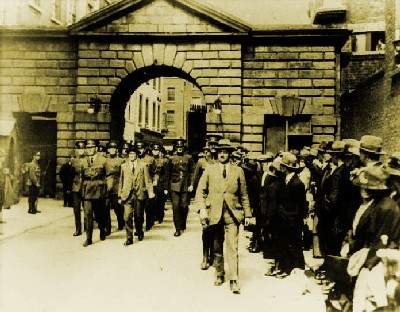
The Civic Guard enter Dublin Castle 17 August 1922
Courtesy - Garda Museum
These illustrations are reproduced here by kind permission of F. Glenn Thompson, is a founding member of the Garda Síochána Historical Society and one of its most active members. He illustrated many uniforms worn by the police and military in Ireland. Glenn is also a member of the Military History Society of Ireland. His illustrations clearly show the influence of military uniforms on those worn by the police.
On 30 June 1998, he launched his book titled "The Uniforms of 1798-1803" (Four Courts Press, Dublin, 1998). The book written
and illustrated by Glenn commemorated the bicentenary of the 1798 Rebellion and contained illustrations of the weaponry, battle standards and uniforms worn by the combatants.
F. Glenn Thompson's illustrations are also
reproduced here by kind permission of Brendan Colvert, Editor of the Ireland's IPA Journal. These
illustrations first appeared on the covers of various Irish IPA magazines in the late 1970s and
early 1980s.
- F. Glenn Thompson, Garda Síochána Historical Society.
- The Irish IPA Journal, and its editor Brendan Colvert.
- The Irish Police, Séamus Breathnach, Anvil Books, Dublin 1974.
- The Royal Irish Constabulary, Jim Herlihy, Four Courts Press, Dublin 1997
- A History of the Garda Síochána, Liam McNiffe, Wolfhound Press, Dublin 1997.
- The Garda Síochána Museum.
|